Data Mesh vs Data Lake: Which Fits Pharma?
Why Architecture Is a Strategic Decision
Data-driven decision-making sits at the core of modern pharmaceutical innovation. Clinical development, real-world evidence, pharmacovigilance, and personalised medicine all depend on seamless access to high-quality, trustworthy data. Yet most organisations continue to struggle with silos, duplicated pipelines, and governance headaches that slow down the very AI initiatives they are investing in.
The numbers make the stakes clear. The global pharmaceutical analytics market, valued at $5.16 billion in 2024, is projected to reach $18.49 billion by 2031. AI has already reduced drug discovery timelines by an estimated 30% in organisations that have invested in the right data foundations. But without the right architecture, even the most sophisticated AI model cannot deliver reliable insights: it will simply surface garbage faster.
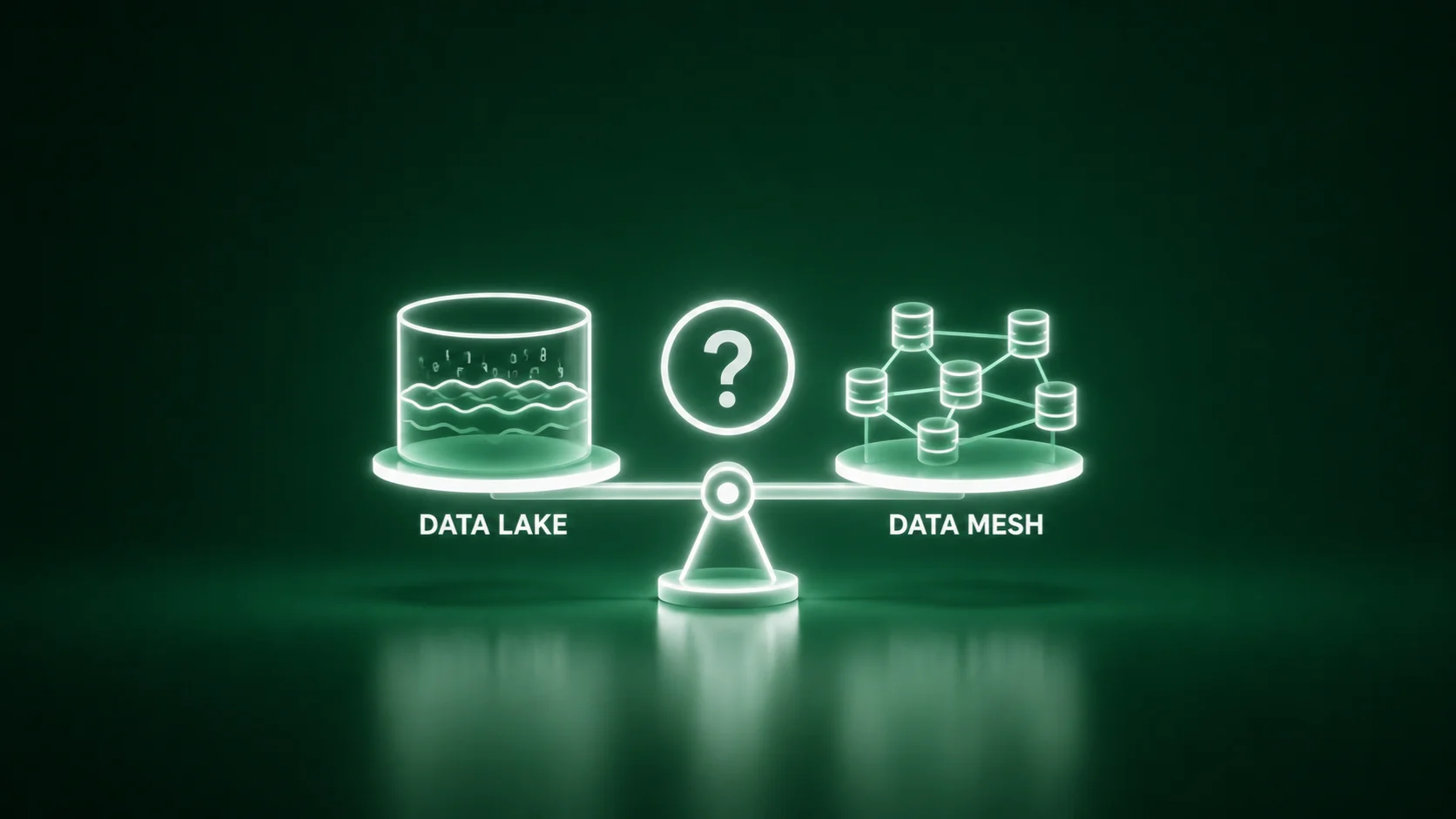
Choosing between a centralised Data Lake and a decentralised Data Mesh is therefore not a technical debate to be left to IT. It is a strategic decision that shapes speed, compliance, and scalability for years ahead. In 2026, with 181 zettabytes of data generated annually worldwide, that decision carries consequences pharma executives can no longer delegate.
The Case for Data Lakes
A Data Lake centralises all structured and unstructured data in a single repository. It is designed to store massive volumes of raw information at low cost, making it particularly attractive for pharmaceutical companies working with multi-modal datasets: lab results, medical imaging, genomics sequences, electronic health record extracts, and wearable sensor streams.
The core strengths are scalability and flexibility. Researchers can run advanced analytics or train machine learning models against a single consolidated source of data. A global pharma company could, for example, pool a decade of oncology trial data into a Data Lake and use AI to detect patterns in patient responses that would be invisible in any individual study. The 42% of pharma firms already using cloud-based platforms report 52% faster trial timelines and 48% improved data integration efficiency, benefits that often originate with a centralised storage layer.
The challenge is governance. Without strict stewardship, Data Lakes become 'data swamps': vast repositories where quality, ownership, and context have eroded to the point where data is effectively unusable. In a regulated pharma environment, where FDA 21 CFR Part 11 and EMA data integrity requirements demand complete traceability, a poorly governed lake is not just an operational problem. It is a compliance liability.
A Data Lake without governance is not a strategic asset. It is a compliance risk waiting to be audited.
The Case for Data Mesh
Data Mesh inverts the centralisation logic. Instead of one giant repository managed by a central IT team, each domain (clinical operations, manufacturing, pharmacovigilance, supply chain, commercial) owns its data as a product. That means each domain is accountable for quality, governance, documentation, and discoverability, not as a burden but as a professional discipline.
For pharma, this maps naturally to organisational reality. Clinical operations teams understand trial data in ways a central data engineering function never can. Pharmacovigilance experts know the subtleties of adverse event classification that matter for regulatory submissions. By treating data as a product, each domain maintains accountability while enabling cross-domain insights through standard APIs and data catalogues.
Adoption is accelerating. According to the State of Data Mesh 2025 report by Monte Carlo Data, 28% of enterprise organisations are now actively implementing Data Mesh elements, up from just 12% in 2023, and 67% are considering it as a long-term strategy. The main barriers remain human rather than technical: 47% cite lack of skills, 39% cultural resistance, and 31% platform costs. Only 8% consider their implementation mature, which means the competitive window for early movers in pharma remains wide open.
In a global oncology programme, for example, trial data, supply chain information, and patient-reported outcomes could be managed independently by their respective domain teams, then connected through standard interfaces. AI models pulling from these trusted, domain-owned data products no longer wait for a central IT queue to clean and validate everything. The result is faster experimentation, higher data trust, and more reliable model outputs.
Lake or Mesh: The Pharma Verdict
The most important insight from 2026 industry practice is that this is not a binary choice. Data Mesh is an operating model. Data Lake is an infrastructure component. The two are not in competition; they address different problems and, in mature organisations, they work together.
Three maturity profiles have emerged in pharma:
- Early-stage or single-division organisations starting their AI journey typically benefit most from a Data Lake. It consolidates fragmented sources quickly, reduces duplication, and gives data science teams a single environment for experimentation. Governance can be added incrementally as the organisation matures.
- Global, multi-domain organisations with complex regulatory footprints across the US, EU, and Asia often find that a centralised lake becomes a bottleneck as it scales. Data Mesh gives each business unit (from clinical to commercial to manufacturing) the autonomy to iterate at its own pace while still contributing to federated governance frameworks like NIS2 and GDPR.
- Hybrid architectures are increasingly the standard in 2026. A Data Lake built on cloud object storage using formats such as Apache Iceberg or Delta Lake serves as the raw storage layer. Data Mesh principles then define how curated data products are owned, governed, and consumed by domain teams and AI workflows on top of it.
The question is therefore not 'Data Lake or Data Mesh' but rather 'what problem are we trying to solve first'. If the priority is speed of AI experimentation with limited governance overhead, a centralised lake may suffice in the short term. If compliance, domain trust, and scalable ownership are critical, a Mesh model delivers a more resilient long-term path.
Building Future-Ready Data Architecture
Preparing for the next wave of AI-driven drug development requires more than choosing the right technology stack. It demands a shift in how pharma organisations think about data ownership, quality, and accountability. Three priorities define the 2026 standard for data architecture readiness:
- Embed governance from day one, not as an afterthought. Whether you start with a lake or a mesh, compliance frameworks such as 21 CFR Part 11, GDPR, and NIS2 should shape your metadata strategy, access controls, and audit trail architecture from the first line of infrastructure code. Over 40% of agentic AI initiatives are expected to be cancelled by 2027 because they were not anchored in governance and business value from the start.
- Empower domain experts as data product owners with proper tooling, training, and accountability structures. The most common barrier to Data Mesh adoption is cultural, not technical. Investing in data literacy across clinical, manufacturing, and commercial teams is as important as investing in the platform itself.
- Invest in interoperable, cloud-native platforms that support hybrid approaches. Apache Iceberg, Delta Lake, and open table formats enable organisations to maintain the economies of scale from centralised storage while applying Mesh principles for data product curation and consumption. Vendor lock-in is an architectural risk as consequential as governance debt.
Data Strategy Shapes Pharma's AI Future
Data is the fuel of pharmaceutical innovation in 2026, but architecture determines whether that fuel drives discovery or stalls progress. Data Lakes provide scale and consolidation. Data Mesh ensures accountability, trust, and domain-level agility. The best-performing organisations will blend both, designing hybrid models that deliver the three things the next generation of pharma AI demands: reliable data, clear ownership, and the flexibility to iterate quickly within a compliant framework.
With AI in pharma projected to grow from $2.35 billion in 2025 to over $7.6 billion by 2034, the organisations that invest now in the right data foundations will compound that advantage over time. Those that defer the architectural decision, or make it without strategic alignment, risk building expensive AI programmes on foundations that cannot support them at scale.

Article by
Sid Ahmed MILISid Ahmed Mili is a digital product strategist and the founder of Numerikraft. He specializes in designing compliant, user-centric web applications and digital platforms for biotechnology and healthcare organizations.
Connect on